 FrogBill
Why most AMCs are priced too low
Many service businesses price an AMC by looking at what the shop down the road charges and taking a little off. The contract sells, but at the end of the year the numbers don't work: three services, two breakdown calls, a long drive to a customer at the edge of town, and a capacitor that was "covered". The AMC kept the customer, but it paid nothing.
The fix is to start from your own costs, then check the market, not the other way round. It takes ten minutes once, and then you have a price list you can defend.
What an AMC price has to cover
- Scheduled visits. Each service takes your technician's time, including the travel to and from the site.
- Travel. Fuel or bus fare, and parking in the city.
- Consumables. Coil cleaner, chemical wash, covers, cotton waste and small fittings used on every visit.
- Breakdown calls. Most AMCs include a few free calls when the AC stops cooling. Not every customer uses them, but you must plan for the average.
- Parts, if the AMC is comprehensive. Capacitors, fan motors, PCBs and the like, spread across all your contracts.
- Profit. On top of cost, not instead of it. It also pays for the office time spent scheduling, reminding and collecting payment.
Step by step
1. Work out your cost per visit
Take what a technician costs you per working hour: their monthly pay, plus any allowance, divided by the hours they actually spend on jobs. Multiply by the hours a visit takes, including travel. Add travel cost and consumables.
Cost per visit = technician cost per hour × hours per visit + travel + consumables
2. Add the year's visits and breakdown calls
Multiply the cost per visit by the scheduled services in the contract, usually 2 to 4 a year for an AC. Then add the breakdown calls you expect for an average customer, not the number you allow. If you allow three free calls and customers use one on average, plan for one.
3. Add a parts allowance for a comprehensive AMC
A non-comprehensive AMC covers labour only, so the allowance is zero and parts are charged separately. A comprehensive AMC includes most parts, so add their expected cost per unit per year. Work it out from your own records: if about 1 in 10 units needs a ₹6,000 part each year and 1 in 5 needs a ₹1,500 part, the expected cost is ₹600 + ₹300 = ₹900 per unit. Keep the big risks, like the compressor and gas after a leak, out of the contract, and say so in writing.
4. Add your profit, then round
Add a profit on cost: 25 to 40% is a reasonable starting point for small service businesses, but choose what your business needs. Round the price up to a clean figure. Then compare it with what others in your town charge. If you are far above them, look at your costs first (long travel and slow visits are the usual cause) before cutting your profit.
5. Add GST if you are registered
AC maintenance and repair services are usually taxed at 18%, shown as 9% CGST and 9% SGST when the customer is in your state. Quote the price with GST shown separately so the customer sees the full amount. If you are not registered, don't add GST.
AMC price calculator
Fill in your own numbers. The price is for one unit for one year and is rounded up to the next ₹50. Nothing you type leaves this page.
A worked example
Anil runs an AC service business in Kochi with three technicians. He wants a price for a non-comprehensive AMC on a 1.5-ton split AC, with three services a year and free breakdown calls. These are the calculator's starting values:
| Item | Amount (₹) |
|---|---|
| Technician time: ₹200 an hour × 1.5 hours | 300 |
| Travel per visit | 100 |
| Consumables per visit | 80 |
| Cost per visit | 480 |
| 3 services + 1 breakdown call on average: 4 × ₹480 | 1,920 |
| Profit, 35% on cost (₹2,592, rounded up) | 2,600 |
| GST 18% (CGST ₹234 + SGST ₹234) | 468 |
| AMC price with GST | 3,068 |
For a comprehensive AMC on the same unit, Anil adds a ₹900 parts allowance. His yearly cost becomes ₹2,820, and the price ₹3,850 before GST. These figures are only an example; your wages, travel and parts history will give different numbers.
Prices for more than one unit
A customer with four ACs at one address saves you three trips. Work out the travel once, not four times, and pass some of that saving on: it's a fair discount you can explain, and offices and apartments compare it. Price units of different types separately, since a cassette or ducted unit takes longer to service than a split.
Upfront or after each visit?
Billing the whole AMC upfront is better for your cash flow, and many home customers prefer one payment. Offices and larger customers often ask to pay per visit or per quarter. Whichever you choose, write it in the AMC agreement, along with what's covered and excluded.
Renewals and price rises
Review your prices once a year, when wages and fuel go up. Raise them at renewal, not in the middle of a contract, and tell the customer before the contract ends. A renewal reminder 30 days ahead, with the new price, gets far fewer complaints than a surprise on the invoice.
Run your AMCs in FrogBill
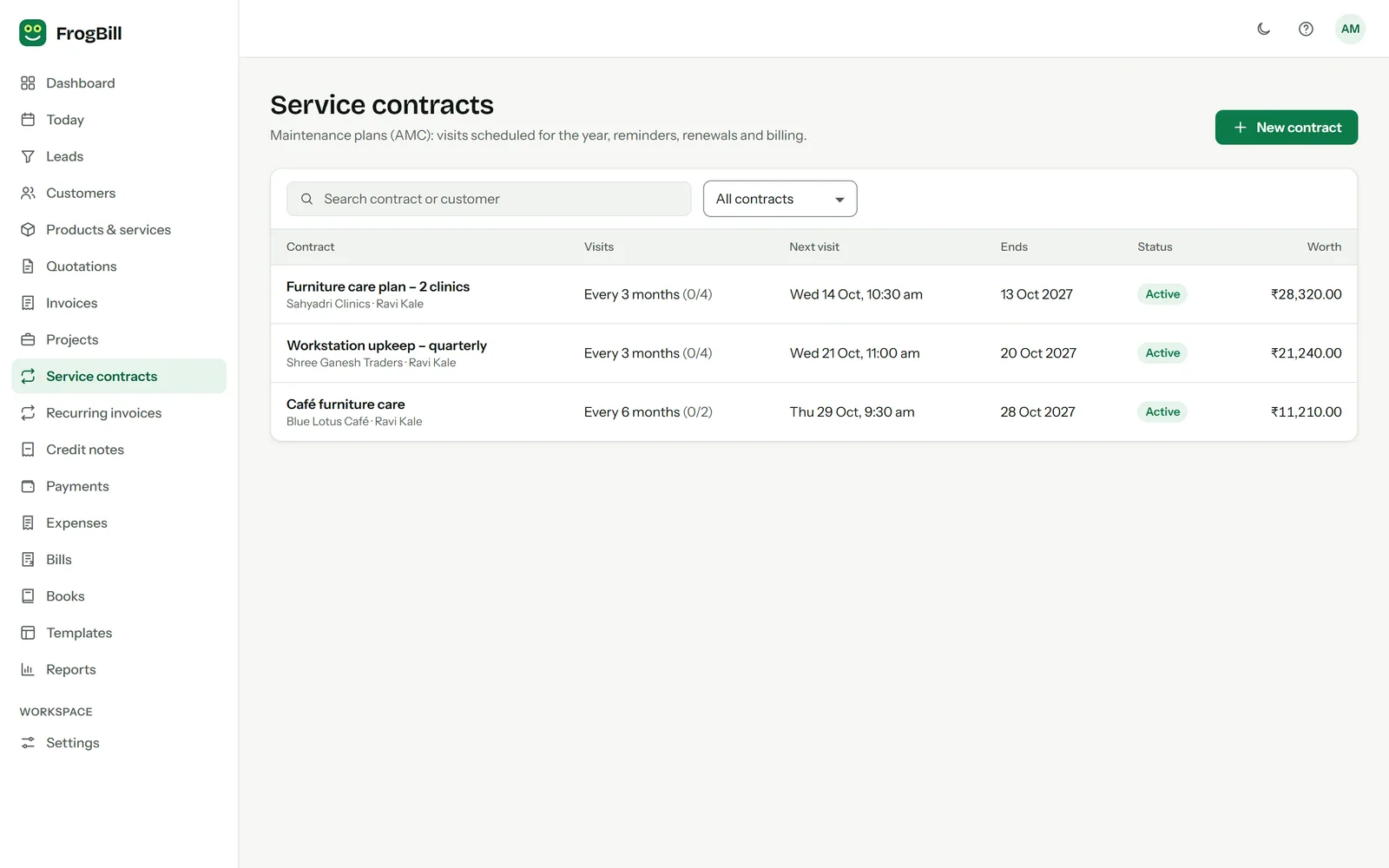
In FrogBill you make the AMC once, with the units, the price and how often to visit. Every visit is planned for the year and assigned to a technician, and the customer gets a WhatsApp reminder two days before each one. Bill the AMC upfront or let FrogBill raise an invoice each time a visit is marked done. Thirty days before the contract ends, you and your customer both get a renewal reminder, and renewing takes one tap.
See FrogBill AMC software and AC service software. AMCs are in the Business plan at ₹299 a month; see pricing.